Built like a mold: why great software is measured in years, not hours

LOAD Team
10 min read • November 12, 2026
A practical guide for industrial companies on how to measure the real value of a digital product.
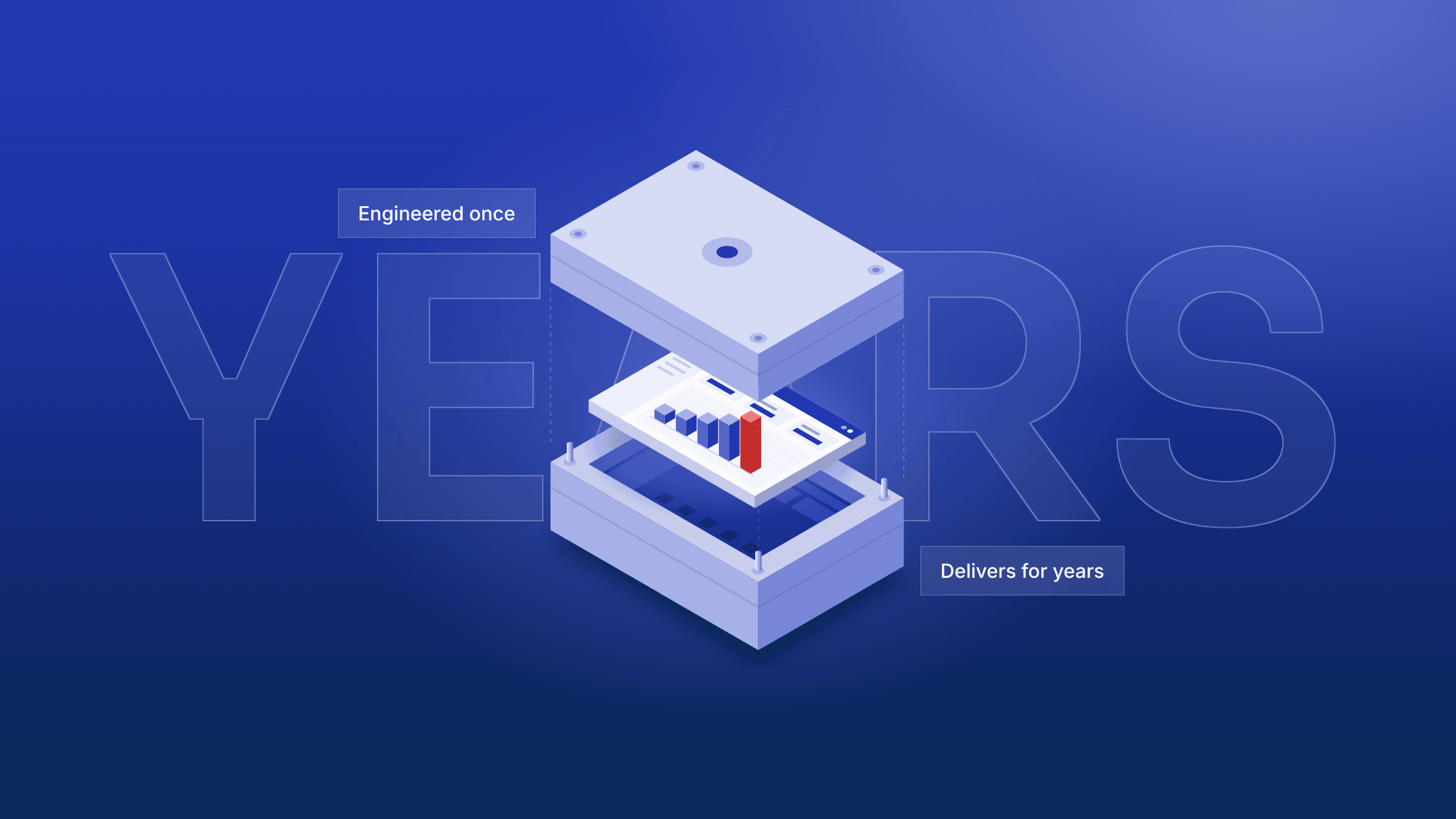
Build like a mold
Ask any plant manager how they judge a good mold, and the answer is never the hours that went into making it. It’s the parts it produces, the tolerance it holds, and how many years it keeps running.
Yet when the conversation turns to software, many companies still judge it by what goes in, not by what comes out. That’s the shift worth making. And the logic behind it already lives on every shop floor.
You already know this logic
Few countries know custom manufacturing like Portugal does. Molds made in Marinha Grande and Oliveira de Azeméis serve some of the world’s most demanding industries.
Nobody judges a mold by the hours it took to build. The client judges it by what it delivers. They know it was designed for one specific part. That it went through engineering, trials, and adjustments before the first good piece came out. And that it will produce, reliably, for years.
The same goes for a special-purpose machine adapted to your line. You don’t buy it from a catalog. You pay for the engineering that makes it fit your process, your materials, and your floor.
Custom software is exactly that. It’s the tool your operation runs on, shaped around how your company actually works. It fits like a glove because it was cut for your hand, not for an average one.
Access isn’t expertise
Here’s where many decision-makers get confused. Technology has never been more accessible. Anyone can open an AI tool, try a vibe coding platform, or download a free template. So shouldn’t building good software be easier than ever?
Not quite. Having access to a tool is not the same as knowing how to apply it to your operation.
Think about a five-axis CNC machining center. Any company with a budget can buy one. Producing a part within tolerance, at the right cycle time, with the right material, takes people who really know what they’re doing. The machine is the easy part.
AI works the same way. Connecting it to your data, making it reliable, testing it against real cases, and keeping it secure takes a team that knows how to build it, use it, and apply it. Accessible technology raised the bar for expertise. It didn’t lower it. And here’s something we often say: AI isn’t the right answer for every company. Many times, the first step is digitizing processes and organizing data. Without that foundation, AI has nothing solid to stand on. A partner who tells you this is worth more than one who sells you AI you don’t need.
The problems we see on Portuguese shop floors
In metalworking, molds, textiles, footwear, and automotive components, the same pains keep coming back:
- Excel as the production system. The ERP handles invoicing and accounting. In practice, the shop floor runs on spreadsheets that only two people fully understand.
- The same order typed three times. Email, spreadsheet, ERP, printed job sheet. Every copy costs time and opens a door for errors.
- Planning on a whiteboard. Nobody knows the real status of an order without walking the floor or making a phone call.
- Traceability your clients demand. International clients and audits ask which lot, which material, which machine. Answering takes days of digging through paper.
- Knowledge that’s about to retire. Your most experienced people know how everything works. Hiring and training their replacements keeps getting harder.
- Data nobody is protecting. Critical files on an old server, backups nobody has tested, and access nobody reviews.
None of this is a failure of your people. It’s what happens when a company grows faster than its tools.
Meet “Metalúrgica Exemplo” (a hypothetical case)
Let’s make this concrete with a fictional company. Metalúrgica Exemplo has around 80 people, a plant in northern Portugal, and most of its clients in other European countries.
Follow one order, from first request to delivery:
- A client in Germany sends a request for proposal (RFP) by email.
- Someone in sales checks prices and lead times in a spreadsheet and drafts the proposal.
- The plant director reviews and refines it, often in a separate copy.
- The proposal goes back to the client. Once it’s approved, the purchase order (PO) arrives.
- The same data gets typed into the ERP.
- The planner prints a job sheet and walks it to the shop floor.
- Operators write times and quantities on paper. At the end of the week, someone types those notes back into a spreadsheet.
- The client emails asking for a delivery date. It takes three phone calls to find out.
Nobody here is doing anything wrong. Every step makes sense on its own. Together, they quietly eat the company’s capacity.
Now some illustrative numbers, not real data. Say three people spend two hours a day re-entering data and chasing information. That’s six hours a day. Across roughly 220 working days, it adds up to about 1,320 hours a year. Close to three-quarters of a full-time job, every single year, spent on work that creates no value. And that’s before counting the wrong references, the rework, the late deliveries, and the requests Exemplo couldn’t answer in time because nobody could confirm capacity.
What standing still really costs
Instead of quoting industry averages, here’s a simple way to estimate what your current process costs you every year:
- hours lost per week × cost per hour × 48 working weeks
- plus the yearly cost of errors, rework, and returns
- plus the margin on orders you couldn’t accept or deliver on time
- equals what your current process really costs you, every year
Then set that number against what the right software gives back: hours, fewer errors, orders you can finally say yes to, year after year. That’s the comparison that matters.
Measure the outcome, not the input
Software projects are often judged by their inputs: hours, sprints, features delivered. But none of those tell you whether the project worked.
The questions that do are about outcomes. How many hours does your team get back every month? How many errors never happen? How quickly can you answer a client asking for a delivery date? How many years will the software keep doing that?
Good software isn’t measured in hours of code. It’s measured in hours given back.
Where the value gets built
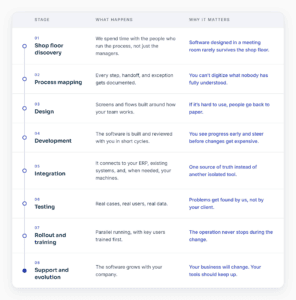
Writing code is only one line of this table. The rest is what separates software that gets used from software that gets abandoned.
When custom software isn’t the answer
We’d rather lose a project than sell the wrong one. Custom software doesn’t make sense when:
- The process is standard. For accounting, payroll, or email, a good off-the-shelf tool is the right choice.
- The problem is organizational. Software can’t fix unclear responsibilities or decisions nobody wants to make.
- Nobody can name the process that hurts. If the pain isn’t clear yet, the first step is diagnosis, not development.
Built in from day one
Whatever process we start with, two things come built in.
- Room to grow. Software that only works at today’s size becomes tomorrow’s bottleneck. We design the architecture, data, and integrations so the software grows with your company, without a rewrite every time you add a line, a plant, or a market.
- Security and compliance by design. Access control, data protection, and the requirements your clients and auditors expect, from lot traceability to GDPR, are part of the design, not an audit at the end. It’s the same discipline we apply to medical device software under our ISO 13485 quality system.
How LOAD works with industry
We don’t start by rebuilding everything. We start with one process: the one that loses the most hours or creates the most errors. We map it on the shop floor, with your people. We build it, run it alongside the current process, and measure what changes. When the numbers prove the value, we grow from there. The result is software that fits your operation like a glove and keeps fitting as you grow. Built like a good mold: for your part, your line, and many years of production.
Want to see what the right software could give back to your operation? Let’s map it together.
LOAD Team